

A real example from our laboratory: why, when the heads of a hard drive are replaced, it is not enough for the donor to be the same model.
1. The heads fly a few nanometres above the platter
The heads of a hard drive read and write data without touching the platter: they fly over it at a distance of only a few nanometres, that is, millionths of a millimetre. To hold that exact distance, each head has a tiny heater. As it warms up, the tip of the head expands and moves closer to the platter.
At the factory, the drive measures how much heat each of its heads needs in each zone of the platter to sit at the correct distance, and stores those values in its firmware. We call that set of values the thermal profile.
Every head is different
Because of small manufacturing differences, each head needs a different amount of heat to reach the same distance from the platter. That behaviour belongs to each individual part and cannot be changed.
2. What happens when a donor head with a different profile is fitted
When the heads have to be replaced (a head swap), the drive firmware keeps applying the heat it calibrated for the original heads. If the donor needs a different amount of heat, it ends up working at the wrong distance:

- If the donor needs less heat, it receives more than it should, drops too low and may touch the platter. That contact wears away the magnetic layer, which is where your data is stored, and the damage is permanent.
- If the donor needs more heat, it stays too far away: reads are weak, errors appear and the work becomes slow and unstable.
In SMR drives the margin is even smaller. The tracks overlap like roof tiles and the drive itself reorganises data continuously, so an unstable head can affect whole areas of the platter and the internal tables the drive uses to locate its data.
3. A real example: two drives of the same model
To illustrate this, we compared the thermal profile of two drives of the same model, with 10 heads each, handled in our laboratory. Let drive A be the patient and drive B a possible head donor. Although the example uses Seagate drives, the principle is the same for every brand.
| Drive A (patient) | Drive B (possible donor) | |
|---|---|---|
| Brand | Seagate | Seagate |
| Model | ST5000LM000-2AN170 | ST5000LM000-2AN170 |
| Capacity and form factor | 5 TB · 2.5" | 5 TB · 2.5" |
| Heads | 10 | 10 |
| Serial number | WXXXXXXR | WXXXXXX9 |
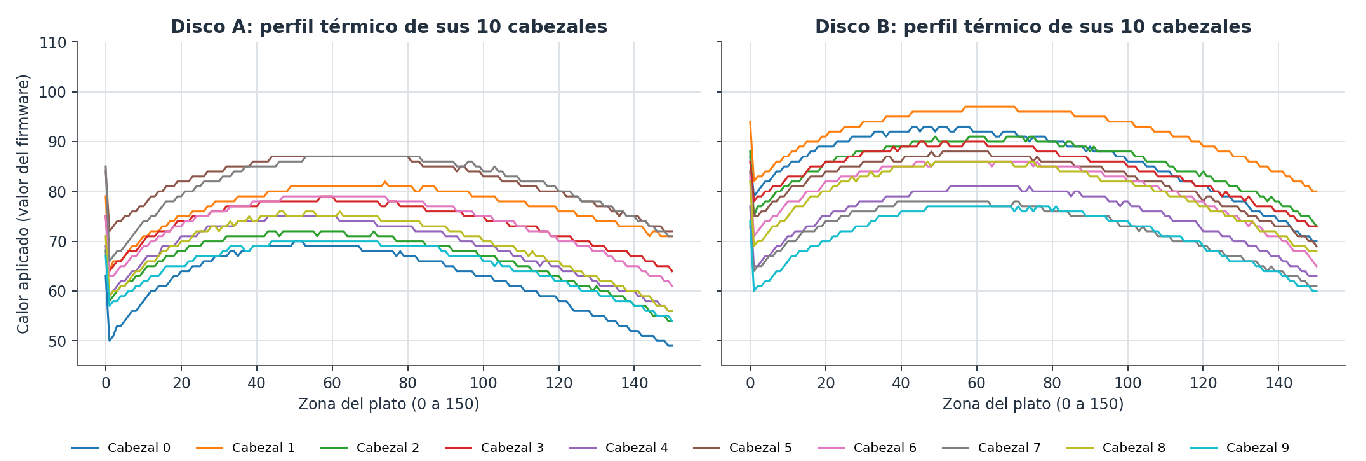
The curves of the two drives share the same general shape, because that is the design of the model. But each head has its own level, and the order is not repeated from one drive to the other: the heads that need the most heat on drive A are not the same ones as on drive B.
4. The comparison, head by head
To compare them, we calculated the average heat of each head across the whole platter and subtracted the value for drive A from the value for drive B. The closer the difference is to zero, the more alike the two heads are.


| Head | Drive A (patient) | Drive B (donor) | Difference (B − A) | Result | What would happen with the donor |
|---|---|---|---|---|---|
| 0 | 62.3 | 86.0 | +23.7 | Different | Much further away: weak reads |
| 1 | 77.0 | 91.7 | +14.7 | Different | Much further away: weak reads |
| 2 | 66.5 | 85.6 | +19.1 | Different | Much further away: weak reads |
| 3 | 73.6 | 84.4 | +10.8 | Different | Much further away: weak reads |
| 4 | 68.7 | 75.3 | +6.6 | Similar | Somewhat further from the platter |
| 5 | 82.1 | 82.3 | +0.2 | Very similar | Would work practically the same |
| 6 | 73.4 | 80.6 | +7.2 | Similar | Somewhat further from the platter |
| 7 | 81.5 | 72.5 | −9.0 | Similar | Closer to the platter: risk of contact |
| 8 | 69.2 | 80.1 | +10.9 | Different | Much further away: weak reads |
| 9 | 65.1 | 71.4 | +6.3 | Similar | Somewhat further from the platter |
Reading the result
- Only head 5 on drive B behaves practically the same as the original.
- Eight of the ten heads on drive B need more heat than the originals. With the patient's firmware they would sit too far from the platter and reads would be weak or unstable.
- Head 7 does the opposite: it needs less heat. With the patient's firmware it would receive more heat than it should and work closer to the platter than it ought to, with a risk of contact.
Conclusion of the example
Even though both drives are the same model, drive B would not be a good donor for drive A. Fitting its heads would put the patient's platters at risk. The right course is to keep looking for a head set whose profile is closer to the original.
5. What we do in the laboratory
- We look for donors of the same model and firmware version, and check their manufacturing data (plant, date and head map).
- We compare the thermal profile of each candidate with that of the original drive, head by head.
- We choose the closest head set, so the drive works with the smallest possible adjustment.
- We confirm that the drive runs stably before we start copying its data.
The firmware can be partly readjusted, but the physical behaviour of a head cannot be changed. That is why the safest approach is to find the donor that most closely matches the original. The search may take additional working time, but it is the responsible way to protect your data throughout the process.
Note: heat values are internal units of the drive firmware. They are used to compare heads with one another and do not translate directly into a distance in nanometres. The example corresponds to real drives handled in our laboratory; serial numbers are partly masked to protect their owners' identity. The same principle applies to drives of every brand.
R&D Department, Advanced Data Recovery. IT & Data Services S.A. de C.V. (Mexico) and Tecnología y Negocios del Caribe C.A. (Venezuela).
Services related to this article


